• On page 107, in an article about Ellis Island, now known as Ellis Island National Monument, we mentioned that the very first person to pass through the then brand new federal immigration station, on January 1, 1892, was a 15-year-old girl from Ireland named Annie Moore.
• Yesterday we received an email from BRI fan Nicole H, who said:
For reasons only the mind-faeries know I just thought of the old drive-in theater that I grew up a short walk through a yard and a field from in Western New York. And lo and behold—I found it on the internet. In severalplaces. There’s even an aeriel photo of the site (at the first link) from 1978. And my house is even in there—who knows, I may have even been standing in the yard at the time! (Click pix to enlarge.)
There was a segment on NPR this morning about the growing number of higher education students defaulting on federal school loans. The numbers are astounding: More than 238,000 students with federal loans are in default. And we’ve all heard the horror stories of students accruing debts that will take a decade—or decades—to pay back. (That’s crazy!)
We’re deep on deadline here at BRI headquarters, and I’m just polishing up a page on fascinating brain facts—”Your brain is so soft it can be cut with a butter knife” is a fun one. I just came across this bit of info: The earliest known realistic depiction of a human brain was made just 500 or so years ago. Imagine that. Of all the tens of thousands of years that modern humans have been around, we didn’t, at least according to the article linked, get a good drawing of that most vital of organs—the brain—until just a few centuries ago. Almost makes you feel young, doesn’t it?
A little less-than-light reading on Brigadier General Norm Cota, one of the highest ranking officers to actually fight his way up the beach that June 6 long ago.
Cota was played by actor Robert Mithcum in the epic D-Day film, The Longest Day. Here’s the trailer. (Cota’s character appears for just a second toward the end.)
“The creator of Tom Sawyer, Huckleberry Finn and some of the most frequently misquoted catchphrases in the English language left behind 5,000 unedited pages of memoirs when he died in 1910, together with handwritten notes saying that he did not want them to hit bookshops for at least a century.
That milestone has now been reached, and in November the University of California, Berkeley, where the manuscript is in a vault, will release the first volume of Mark Twain’s autobiography. The eventual trilogy will run to half a million words, and shed new light on the quintessentially American novelist.”
Well the good people running George’s estate, Mount Vernon, have returned a copy of the same edition of the book to the library. (But not the fine—which would be in the neighborhood of $300,000.)
The New York Times reports that the last of the chorus girls from the one-time American entertainment institution, the Ziegfeld Follies, has died:
“For a quarter century, Florenz Ziegfeld auditioned hundreds of thousands of young women vying to become chorus girls, the Ziegfeld Girls, those lace and chiffon visions of glamour who were as much a part of the Jazz Age as Stutz Bearcats, the Charleston and F. Scott Fitzgerald.
In all, from 1907 to 1931, he picked about 3,000, and on Tuesday the last Ziegfeld Girl died. She was Doris Eaton Travis, and she was 106.”
She had quite a story:
Mrs. Travis may have been the youngest Ziegfeld Girl ever, having lied about her age to begin dancing at 14. She was part of a celebrated family of American stage performers known as “the seven little Eatons.” George Gershwin played on her family’s piano, and Charles Lindbergh dropped by for “tea,” Prohibition cocktails.
And she kept on dancing until she was 104, and even appeared at a charity event just two weeks ago.
• Here’s a book that was written about Mrs. Travis in 2006, Century Girl:
Similar in approach to a graphic novel, this biography-in-collage tackles the life of Ziegfeld Follies star Doris Eaton. Each page offers a wild mix of illustrations, doodles, photos and memorabilia from Eaton’s archives, accompanied by handwritten text outlining her fascinating life, which comes across like something out of the musical Gypsy.
Founder of a nation, trouncer of the English, God-fearing family man: all in all, George Washington has enjoyed a pretty decent reputation. Until now, that is.
The hero who crossed the Delaware river may not have been quite so squeaky clean when it came to borrowing library books.
The New York Society Library, the city’s only lender of books at the time of Washington’s presidency, has revealed that the first American president took out two volumes and pointedly failed to return them.
At today’s prices, adjusted for inflation, he would face a late fine of $300,000.
It should be noted that this story is from a British news source, so it should be taken with a grain of sore loser salt.
And holy cow—we’ve just found a terribly incriminating photo of the Father of our Nation about to engage in one of his notorious book thefts! Join us after the jump for this shocking, never before seen photo!
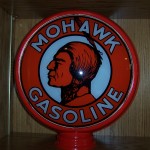
While performing an important search for an article one day—okay, I admit it, it was this morning, and I was bored, and I put “pergle” into Google just to see what would happen, you caught me!—I found this blast from the past: Pergl Gas Pump Globes. Remember those?
“Gas globes are spherical glass signs that sat atop gas pumps in the first half of the 20th century, advertising a specific oil company or brand of gasoline. Generally made from a ring of metal with a lens mounted on either side, they were produced in various shapes (like the Shell clamshell) and innumerable designs.
The purpose of gas pump globes was brand identification for drivers at a distance. Lighting wasn’t as good on gas stations as it is today. Sometimes all a motorist could recognize driving by was the gas pump itself lit up, and the globe glowed so they’d know what brand of gas was available. Post World War II, pumps started getting smaller, and by the 1960’s, it was unusual to have a globe.”
Pergl makes reproductions, but there are of course lots of dealers in actual antiqueglobes, and over at OldGas.com, “The Gas Station & Auto Service Collectibles Web Site,” they have a huge gallery of photos of vintage globes.
1972? Hasn’t the Goodyear Blimp been around for a bit longer than that? Uh, yes, it has. But since it now exists only after March 8, 1972 – on the internet, where reality goes to die – we’d like to say “Happy Birthday, Blimp.” What the heck, y’know?