• In 2003, wildlife conservation officers in Michigan faced a spate of illegal turkey poachers. They didn’t call the Detroit police, one-time employer of Robocop—they brought in Robo Turkey. Several models of the $1,000 animatronic bird were placed in fields and woodlots around the state’s northern counties to protect wild turkeys. Robo Turkey looks like the real thing…from a distance. Officers can operate the bird via remote control to make him move around and shake his tail feathers, in order to attract illegal hungers. Robo Turkey has caught hundreds of poachers in the past decade.
• In 2000, a mysterious man named “John Titor” started posting messages on Internet paranormal discussion forums claiming to be a time traveler from the year 2036. He’d been sent back in time by the U.S. government, he said, to fix software bugs that were making computers in the future malfunction. Titor not only showed off pictures of his time machine (a modified 1967 Camaro), but detailed the scary world events between the years 2000 and 2036. For example, from 2004 to 2008, the second American Civil War was waged; that the 2004 Olympics were the last ones ever held; and that in 2015, Russia started World War III by dropping nuclear bombs on China, the U.S., and most of Europe. Three billion people died and all major world governments crumbled. In March 2001, Titor claimed his IT duties were complete and he “returned” to 2036…which means he never posted on Internet forums again. Obviously, you can figure out that Titor’s details of the future history weren’t quite accurate, making this a hoax. But who was behind it? Nobody knows.
It’s Friday, and that means it’s time to try to fake you out. Two of three stories about stuff being stuffed where it shouldn’t be stuffed are real…and one we made up. Can you guess which one is the fake? Pick your answer at the end of the article and see if you’re right.
Details: French cooks can make even a doughnut—simple dough, cooked in oil—seem fancy. “Beignet” is a deep-fried pastry made out of a versatile dough base called choux. Consisting of little more than butter, flour, eggs, and water, the same dough is used to make other French desserts, including éclairs and profiteroles. A beignet is usually rectangular, served hot, and topped with a mound of powdered sugar.
• It’s political lore that John F. Kennedy won the 1960 election on the strength of the first-ever televised presidential debates: Kennedy appeared calm and collected, and wore makeup to look good on TV, while his opponent, Richard Nixon, seemed nervous and sweaty. Kennedy may have won the image game, but the debates didn’t hand him the keys to the White House. Gallup polls throughout 1960 show a very close race…and so did the outcome. Kennedy beat Nixon handily in the Electoral College (303 to 219), but got just 112,000 more votes, out of 68 million total.
Earlier this year, United Nations secretary-general Ban Ki-Moon, along with a coalition from Singapore, introduced a resolution to declare November 19th the first “World Toilet Day.” That sounds lighthearted or silly, but then maybe here in the U.S. we take for granted our widespread sanitation and consistent access to toilets. Worldwide, the lack of sanitation and toilets is a public health crisis. “Sanitation is central to human and environmental health,” Ban said. “It is essential for sustainable development, dignity, and opportunity.” In other words, it’s a basic human right that a lot of humans do not get to enjoy.
The PlayStation 4 just came out, so here’s some trivia about the first three: 5 facts about PlayStation.
• In the late ‘90s, Sony manufactured the audio processors for the Super Nintendo system. Seeing how much money Nintendo was making, the company decided to make its own system. At the same time, it was working with Phillips Electronics to improve CD-ROM technology. Sony figured out how to run data, graphics, and audio from a CD-ROM simultaneously and super-fast. Result: It could put highly advanced video games on discs, a gaming first. Disc games are also much cheaper to manufacture than cartridges, the traditional delivery method for video games.
• Video game industry analysts predicted the PlayStation to fail shortly upon its release in 2000. Why? Because at that point, only software manufacturers like Nintendo and Sega had successfully launched a video game console. Strictly electronics companies, like Sony, had a long history of releasing flop systems, such as RCA’s Studio II, Fairchild’s Channel F, and Magnavox’s Odyssey.
Introducing a new feature on Uncle John’s Blog. Each Friday, we’ll give you three bizarre news stories. Two of them are real; one we completely made up. Can you guess which one is the fake? Pick your answer at the end of the article and see if you are right.
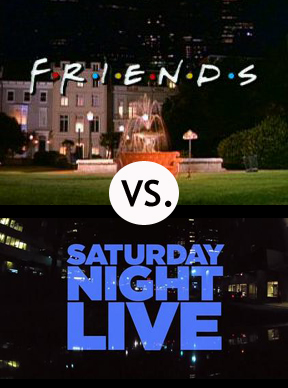
In the 1992-93 TV season, Aniston starred on a short-lived sketch comedy show on Fox called The Edge. Not very many people watched the show (it was cancelled after 18 episodes), but producers at Saturday Night Live must have. Aniston was asked to audition for that show, and she was asked to join the cast for the 1994-95 season. Aniston turned them down, feeling that the pilot she’d just shot for an NBC sitcom called Friends had some promise.
In 1959, a group of Japanese investors tried to convince executives at the Walt Disney Company to build a second Disney theme park… in Japan. Disney liked the idea, but not the location and opened a sister park for its Disneyland in California with Disney World in Florida. Undeterred, the consortium decided to move forward without Disney’s blessing and build an exact replica of Disneyland in Nara, Japan. Opening in 1961, Dreamland had all of the amenities of Disneyland, such as replicas of Sleeping Beauty’s Castle, The Jungle Cruise, Autopia, the Matterhorn, a monorail, and even a Main Street USA recreating that old timey small town Americana feel for Japanese tourists. Dreamland was the top amusement park in Japan throughout the ’60s and ’70s…until the genuine article Tokyo Disneyland opened in 1983. Dreamland closed for good in 2006.
The Book of Revelation was written in Greek sometime between 70 and 95 A.D., by an author known only as John. While its most commonly associated with scary, cryptic, or apocolyptic imagery, it’s really only the 13th chapter of Revelation where that’s present. It begins with a letter to the reader, then describes cataclysmic events of the end times John says he saw in a series of visions.
It’s in Revelation (13:8) where “666” is mentioned—the only time in the Bible: “Here is wisdom. Let him that hath understanding count the number of the beast: for it is the number of a man; and his number is Six hundred threescore and six.” Doing a bit of quick math, in which a score is 20, the number adds up to 666. Whoever is represented by this number then, the text indicates, is pure evil.
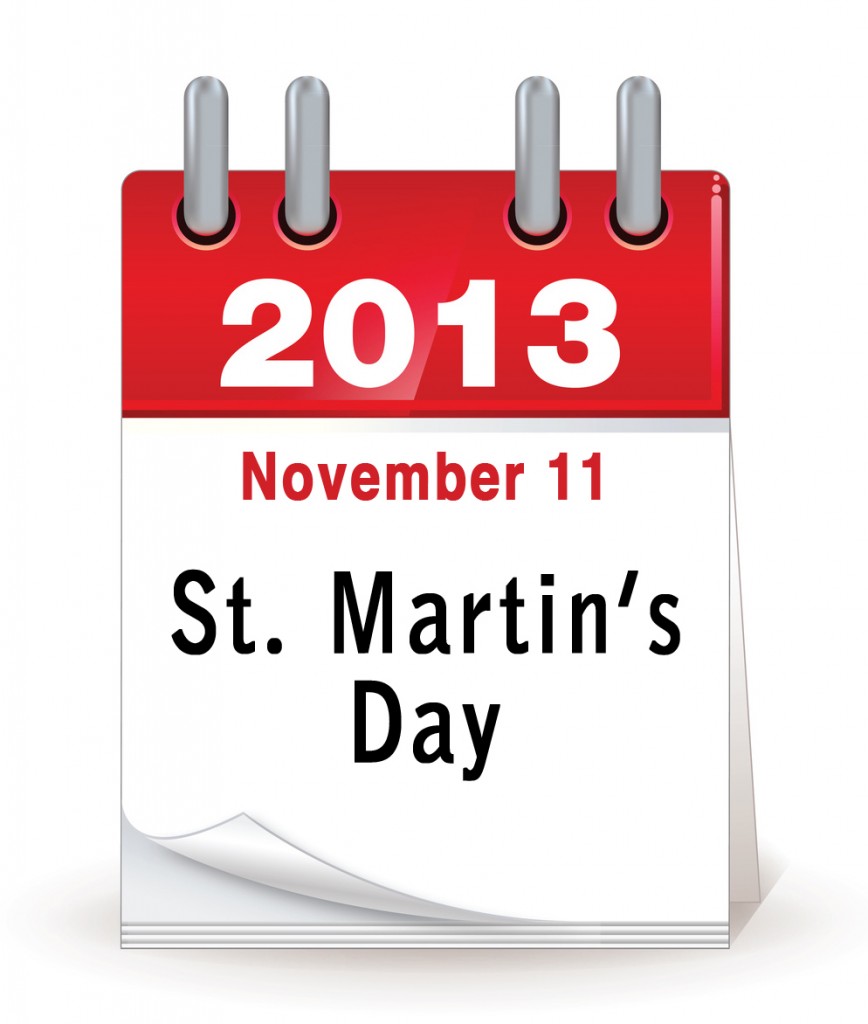
Martin of Tours seemed like a decent guy. Legend has it that in the 4th century, he gave up his job as an elite soldier in the Roman army to become a priest after helping out a beggar one night. He ultimately became a bishop, and a pacifist devoted to spreading peace, love, (and Christianity) across western Europe.
He was sainted shortly after his death, and his feast day is November 11, marking the day he was buried in 397. Though obscure in the U.S., St. Martin’s Day is widely celebrated in Europe, making it one of the oldest continuously observed holidays in the world.
The customs vary by location, and many are reminiscent of American customs for other holidays:
• In Belgium and the Netherlands, St. Martin’s Day is celebrated much more like Halloween. Children make paper lanterns and, once its dark, go door-to-door in search of candy. Instead of saying “trick or treat,” they sing songs or recite poems about St. Martin. In some communities, the search for candy begins at a local church and the kids are marched through the streets with a horseback actor dressed as Saint Martin leading the way. Afterward, there’s often a bonfire in a large public square and everybody eats pretzels.
• Humans began cultivating roses only about 5,000 years ago, in China and the Far East. But they’ve been used and enjoyed by humans for much longer than that. Ancient Egyptian mummies have been discovered wearing rose wreaths. Fossilized rose remnants have been found that date back 35 million years.
• A rosebush blooms on the wall of Hildesheim Cathedral in Germany. It started growing at about the same time the church was built, around 1010, making it the oldest living rosebush on the planet.
• In the early 1800s, Empress Josephine of France engineered the first modern-day “rose garden.” She had a lofty goal—a sample of every rose variety in the world. Her gardens at the Malmaison château housed 250 varieties of roses—helped along by a standing order to the French Navy to confiscate any rose plants or seeds found on enemy ships.
• Josephine’s garden made rose growing and collecting very popular in western Europe. In the mid-1800s, gardeners figured out how to crossbreed roses, to combine, for example, one rose’s color with another’s heartiness. The first major hybrid rose: “La France,” developed by grower Jean-Baptiste Andre Guillot in 1867. Today there are over 10,000 hybrid rose varieties.
• While it probably didn’t have every rose in the world, Josephine’s was the largest rose collection in the world until the opening and rapid growth of the Europa-Rosarium in Sangerhausen, Germany, in 1902. As of 2013, it houses 75,000 rose varieties.
The house, placed in a quiet neighborhood in a suburb of Las Vegas, was later given away in a contest, but the winner opted for a $75,000 cash prize instead of the house. More than 30,000 people visited the house in 1997 (including Simpsons creator Matt Groening who signed one of the walls with purple paint), but neighbors weren’t too pleased with all the tourist traffic. The house was repainted and most of the details related to the show were removed before it was sold in 2001.
Tallest: Romanian-born Gheorghe Muresan center, at 7’7”. He came to the NBA after playing professionally in France. Drafted by the Washington Bullets in 1993, he averaged a respectable 9.8 points over his seven-year NBA career, as well as 1.5 blocks. However, Muresan is probably best known for his of-court activities—he starred in the 1998 movie My Giant with Billy Crystal (Muresan played the giant).
Shortest: Tyrone “Muggsy” Bogues played in the NBA from 1987 to 2001, despite being just 5’3” tall. Being small in the NBA means being fast, and Bogues was adept at assists and steals—he’s the Charlotte Hornets’ all-time leader in both categories.
Biggest: Featuring players who are routinely more than seven feet tall, the NBA is naturally going to have players who weigh a lot. However, only 12 players in league history have ever weighed more than 300 pounds. Among that group are Jerome “Big Snacks” James, Robert “Tractor” Traylor, and Charles Barkley. The heaviest player in NBA history: Oliver Miller, who played for five teams in the 1990s and weighed 375 pounds.
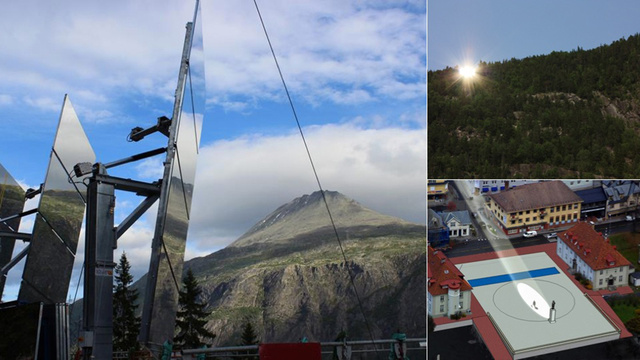
Seven months of near darkness can get anybody down, as well as deprived of Vitamin D. Fortunately for the residents of Rjukan, there’s a high-tech cure for the wintertime blues.
Nearly seven months of that kind of gloom can get anybody down, even Vitamin D deprived Norwegians that are accustomed to harsh winters. Fortunately for the residents of Rjukan, there’s a solution. At a cost of 5 million Norwegian Kroner (roughly $841,000 in US dollars), three 183-square foot mirrors were installed on a cliff overlooking the town. On clear days – which are unable to discern from the ground in Rjukan – the mirrors reflect the sunlight down into the town square.
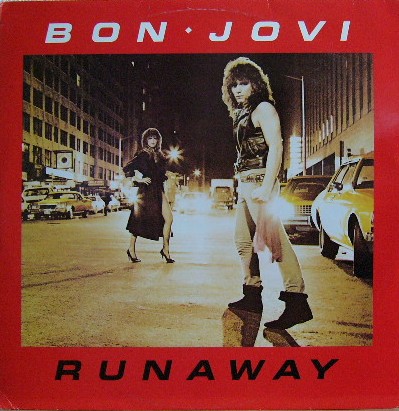
Jon Bon Jovi assembled his hard rock band, Bon Jovi, in 1983, which included bassist Hugh McDonald, who played on the group’s first single “Runaway.” The song was a local hit, and when the group got a record deal, Bon Jovi replaced some of his band members, including McDonald, with a new bass player, Alec John Such. Except…he really didn’t. Such was credited as the bass player on five multi-million-selling Bon Jovi albums, but it was really McDonald who was playing. Why was Such, who was reportedly not as accomplished a musician as McDonald, presented as Bon Jovi’s bassist? McDonald was a decade older than Jon Bon Jovi, Such, and the other members of the band. When the band became teen idols in the 1980s, youth (and youthful looks) were important, and McDonald didn’t fit that profile. In 1994, McDonald “replaced” Such, both in concert and on record.
Because they make more money that way. The price for a gallon of gas listed, $3.49 9/10, is rounded up to the next penny. But most customers don’t pay any attention to that fraction, focusing instead on the standard three-digit price, falling for a classic psychological trick that makes customers think they’re paying slightly less for something than they really are. It’s the same psychology behind why things that cost 99 cents “feel” so much cheaper than something that costs $1.
The fractional pricing practice began during the Great Depression. To save money, people were driving less, and the demand for gasoline. Gas station chains introduced premiums to attract customers, such as free glasses, candy, and ashtrays, for example. Another way a gas station could differentiate itself from the competition: lower prices. Undercutting the other guy by even a fraction of a cent was enough to lure customers. The 9/10th became permanent in the 1970s. During that decade’s oil crisis and subsequent gas shortage, the federal government stepped in to regulate gas prices, setting them with elaborate but precise formulas, which often ended in 9/10ths. The idea simply became a part of American life after that.



 • In 2003, wildlife conservation officers in Michigan faced a spate of illegal turkey poachers. They didn’t call the Detroit police, one-time employer of Robocop—they brought in Robo Turkey. Several models of the $1,000 animatronic bird were placed in fields and woodlots around the state’s northern counties to protect wild turkeys. Robo Turkey looks like the real thing…from a distance. Officers can operate the bird via remote control to make him move around and shake his tail feathers, in order to attract illegal hungers. Robo Turkey has caught hundreds of poachers in the past decade.