Amou Haji is eighty years old. He lives in Iran. And he hasn’t bathed since the Eisenhower administration. After experiencing a series of devastating setbacks as a young man several decades ago, Amou Haji decided to become a hermit. He currently resides outside of Dejgah, a rural village in southern Iran. Why isn’t he eager to practice basic hygiene? It’s because Haji believes that cleanliness causes people to get sick.
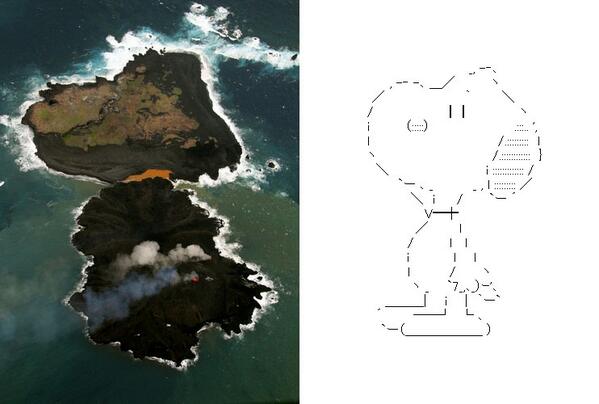
Nishinoshima lies off Japan’s Pacific coastline and is best known for its active volcano, which last erupted in November. The ensuing lava flow created an entirely new island called Niijima. But the volcano wasn’t quite done. In the weeks that followed, it spewed out enough lava to connect the two islands as one. This strange event caused many a volcanologist to cry “good grief!” when they first saw aerial photos of the new, improved Nishinoshima: because the island now strongly resembles Snoopy. However, Japanese scientists aren’t ready to rename it “Snoopy Island” just yet. They say that the volcano is still active and that Nishinoshima’s current shape may only be temporary.
• Humans began cultivating roses only about 5,000 years ago, in China and the Far East. But they’ve been used and enjoyed by humans for much longer than that. Ancient Egyptian mummies have been discovered wearing rose wreaths. Fossilized rose remnants have been found that date back 35 million years.
• A rosebush blooms on the wall of Hildesheim Cathedral in Germany. It started growing at about the same time the church was built, around 1010, making it the oldest living rosebush on the planet.
• In the early 1800s, Empress Josephine of France engineered the first modern-day “rose garden.” She had a lofty goal—a sample of every rose variety in the world. Her gardens at the Malmaison château housed 250 varieties of roses—helped along by a standing order to the French Navy to confiscate any rose plants or seeds found on enemy ships.
• Josephine’s garden made rose growing and collecting very popular in western Europe. In the mid-1800s, gardeners figured out how to crossbreed roses, to combine, for example, one rose’s color with another’s heartiness. The first major hybrid rose: “La France,” developed by grower Jean-Baptiste Andre Guillot in 1867. Today there are over 10,000 hybrid rose varieties.
• While it probably didn’t have every rose in the world, Josephine’s was the largest rose collection in the world until the opening and rapid growth of the Europa-Rosarium in Sangerhausen, Germany, in 1902. As of 2013, it houses 75,000 rose varieties.
In one of the most inexplicable, perplexing, and kind of gross fads of all time, the hottest thing going in the world of coffee are beans that have passed through the digestive tracts of exotic animals. Adherents claim that the premium coffee that results is better than regular coffee. Why? The animals eat only the tastiest, ripest berries from coffee plants, then digest the outer berries, allowing the beans inside pass through their stomachs unharmed, but left coated with amino acids and enzymes. The animals’ feces is collected, with the beans removed, cleaned, and roasted, then ground into a beverage that fans claim is smoother and less bitter than other coffees because of those amino acids and enzymes from an animal’s digestive tract.
The most popular berries-to-butts-to-baristas blend is kopi luwak coffee, made from beans that have passed through the digestive system of the civet, an exotic mammal native to Asia and Africa, also known as a luwak or toddy cat. In 1991 British coffee importer Tony Wild became the first European to offer coffee made from pre-digested beans. The kopi luwak became so popular in Europe that its production is being industrialized, leading to widespread mistreatment of civets. Recently, Wild launched a campaign to end the production and consumption of the special coffee.
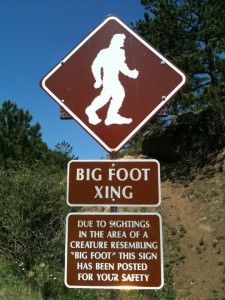
Another possible use: in the big hunt for bigfoot. Jeffrey Meldrum, an anthropology professor at Idaho State University, along with entrepreneur William Barnes, are spearheading a project that will use an innovative new type of drone to search for evidence that Bigfoot actually exists. They call their undertaking “The Falcon Project.” Barnes and Meldrum hope to find enough funding to build the Aurora Mk II, an unmanned, 45-foot-long airship equipped with thermal-imaging equipment and high-resolution cameras. It should be just the tool to scour the forests of the Pacific Northwest day and night, tracking Bigfoot, and, should it find one, take a picture. Unlike more conventional drones, their ship will be quieter and stealthier so as not to scare away their targets. The Aurora Mk II will also be able to travel at speeds of up to 45 mph. The team hopes to launch the ship next year and start sending it on nighttime runs over reputed Bigfoot hotspots around the United States. Over the years, there have been dozens of amateur films that claim to contain footage of real-deal sasquatches—but nothing has ever been confirmed. Earlier this year, however, a couple hiking in British Columbia captured a fairly convincing video of what may (or may not) be one.
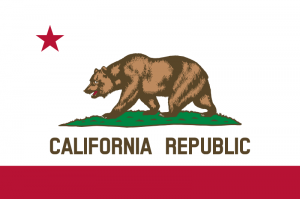
How much do you know about California’s highest, lowest, oldest, largest, and smallest stuff?
TALLEST LIVING THING: Hyperion, a 379-foot Sequoia (California redwood) tree located in the Redwood National Park near Eureka. Hyperion’s location in the park is kept secret to prevent it from being damaged by tourists.
SMALLEST MOUNTAIN RANGE: The Sutter Butte Mountain Range near Yuba City. The buttes are a circular volcanic outcropping just 10 miles in diameter.
OLDEST LIVING TREE IN NORTH AMERICA: A 4,842- year-old bristlecone pine in Inyo National Forest outside Bishop.
Named Methuselah (after the oldest person whose age is referenced in the Bible), this pine was a seedling during the Bronze Age, when the Pyramids were going up in Egypt.
LARGEST LIVING TREE: General Sherman, a giant sequoia in Sequoia National Park, east of Visalia. Named for Civil War general William Tecumseh Sherman, this tree weighs more than 2 million pounds, is 275 feet tall, and is the largest tree on earth when measured by its estimated volume of 52,513 cubic feet.
BIGGEST SOLITARY BOULDER: Giant Rock in Landers in the Mojave Desert. At about seven stories high, it weighs more than 23,000 tons.
LONGEST RUNWAY: At Edwards Air Force Base in the Mojave Desert. It’s 7.5 miles long, and the first space shuttle landed there.
WORLD’S TALLEST ONE-PIECE TOTEM POLE: Built in 1962, the brightly painted 160-foot-tall pole in the McKinleyville Shopping Center was designed by Ernest Pierson, who carved it from a single 500-year-old redwood.
OLDEST CONCRETE BRIDGE STILL IN USE: Fernbridge in Humboldt County. Built in 1911 of reinforced concrete, it crosses the Eel River and is 1,450 feet long.
HIGHEST LANDING PAD ON A BUILDING: The U.S. Bank Tower in downtown L.A. is 1,018 feet high, making it the world’s tallest building with a helipad on the roof. It’s also America’s tallest building west of Chicago.
NORTH AMERICA’S BEST VIEW OF THE WORLD: The 3,849-foot summit of Mt. Diablo in Contra Costa County. It reveals more of the earth’s surface than any other peak in the world, except Mt. Kilimanjaro in Africa. Mt. Diablo looks west to the Farallon Islands in the Pacific, east to the Sierra Nevada mountain range, south to the Santa Cruz Mountains, and north to the Cascades.
NORTH AMERICA’S HIGHEST CONCENTRATION OF LAVA TUBE CAVES: Lava Beds National Monument near Tulelake.
They all look pretty much the same, but while two of them will grab apple right out of your hand (and sit in your lap to eat it, if you let them, as we’ve happily learned in the past), two of them seemed very shy and skittery.
This tiny film doesn’t feature any big stars like Brad Pitt, or even any littler stars—because there literally wasn’t enough room for them. Instead, A Boy and His Atomstars, amazingly, just a few microscopic particles. Guinness World Records has declared the stop-motion-animated short film “the world’s smallest movie.” The 90-second film consists of a “boy” bouncing an atom-sized ball while dancing and jumping around. There’s not much of a plot but given the methods involved, it’s pretty incredible.
IBM scientists created the film with a “scanning tunneling microscope” that manipulated a few dozen carbon atoms placed atop a copper surface. First they had to chill the microscope to just above absolute zero (-450° F) because at a higher temp, the “excitable” atoms would have ignored their stage directions.