
Who Knew Portable Press Had All the Science Answers?
Why are hospitals so cold? Why is urine yellow? How does a gas mask work? Get some answers to popular science questions in our new blog.


Why are hospitals so cold? Why is urine yellow? How does a gas mask work? Get some answers to popular science questions in our new blog.

In July 2021, Amazon founder and multibillionaire Jeff Bezos launched himself into space. What’s more surprising about this? He’s hardly the first non-government-agency-affiliated person to reach the edge of the cosmos. Here’s a brief history of private spaceflight. 1961: Just four years after the Soviet Union launched two Sputnik satellites, the first manmade objects to […]

Neil Armstrong will never fall out of the history books — in July 1969, the astronaut became the first human being to ever step foot on the moon. Here are some little-known facts about the man and his work, which are also the subjects of a new book from Portable Press. Neil Armstrong got into […]

This was a wild, harrowing, and unpredictable year… and one that self-proclaimed psychics somehow didn’t see coming. Here are some events that psychics claimed were supposed to happen in 2020. The world may have avoided a catastrophic attack by this man — psychic Sidney Friedman ominously predicted that “cookies” would “disappear.” Friedman also said that […]

This year, we resolve to write more blog posts about New Year’s resolutions. And look at that, we did it! • Ancient Babylonians started the idea of New Year’s resolutions about 4,000 years ago, although the new year in that society started in the middle of March and lined up with crop-planting season. As part […]
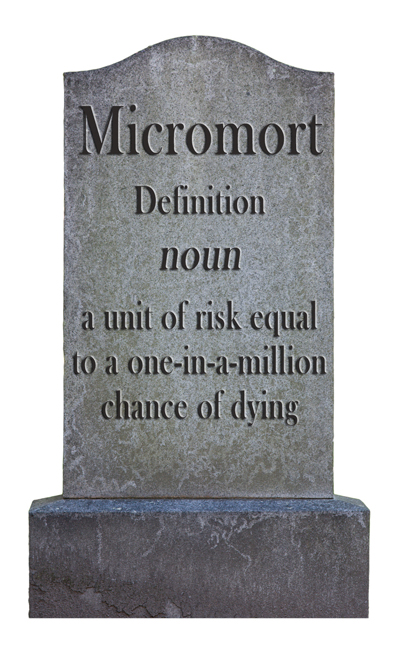
But it’s a very small chance. Behold the morbid mathematical weirdness of micromorts.
In the middle of the 20th century, “risk assessment” became a field of interest for statisticians and actuaries alike. The idea was to create a mathematical model to determine exactly how risky an activity might be—riding a motorcycle or living in a house with a radon gas leak, for example.
But here’s the thing—everything carries with it some kind of risk. You could die by choking on a banana, or from spontaneous combustion. Both are extremely rare possibilities, but they’re possibilities nevertheless.

Scientists have created artificial blood. This is not a plot point from True Blood.
 Researchers at Babes-Bolyai University in Cluj, Romania, spent months trying to develop an artificial human blood substitute. While this could be considered a medical miracle and a marvel of modern science, the best part about this is that Cluj is located in the Romanian region of…Transylvania.

Quieter living through chemistry.
 There’s nothing worse than trying to concentrate on a very important project (like, say, a blog post) while struggling to tune out loud neighbors. If you live or work in an area with heavy traffic or other types of noise pollution, you’ve likely found yourself wishing you could grab a remote control and turn down the volume on the world outside your window.

In honor of the 50th anniversary of “Doctor Who,” here are some stories about some people who claimed to have unlocked the secret of time travel…or maybe not.
 • In 2000, a mysterious man named “John Titor” started posting messages on Internet paranormal discussion forums claiming to be a time traveler from the year 2036. He’d been sent back in time by the U.S. government, he said, to fix software bugs that were making computers in the future malfunction. Titor not only showed off pictures of his time machine (a modified 1967 Camaro), but detailed the scary world events between the years 2000 and 2036. For example, from 2004 to 2008, the second American Civil War was waged; that the 2004 Olympics were the last ones ever held; and that in 2015, Russia started World War III by dropping nuclear bombs on China, the U.S., and most of Europe. Three billion people died and all major world governments crumbled. In March 2001, Titor claimed his IT duties were complete and he “returned” to 2036…which means he never posted on Internet forums again. Obviously, you can figure out that Titor’s details of the future history weren’t quite accurate, making this a hoax. But who was behind it? Nobody knows.

A low-tech/high-tech cure for the winter blues for a city that is is cut off from direct sunlight for five to six months a year.
As the days grow shorter and the nights get colder, a little sunshine can be hard to come by. It’s especially true in Rjukan, a small town in Norway. Because of a nearby, imposing mountain chain, the area doesn’t receive any direct sunlight from September until March.

Seven months of near darkness can get anybody down, as well as deprived of Vitamin D. Fortunately for the residents of Rjukan, there’s a high-tech cure for the wintertime blues.
Nearly seven months of that kind of gloom can get anybody down, even Vitamin D deprived Norwegians that are accustomed to harsh winters. Fortunately for the residents of Rjukan, there’s a solution. At a cost of 5 million Norwegian Kroner (roughly $841,000 in US dollars), three 183-square foot mirrors were installed on a cliff overlooking the town. On clear days – which are unable to discern from the ground in Rjukan – the mirrors reflect the sunlight down into the town square.

Sitting on a smart toilet right now? Better be careful—you might get hacked!
 Japanese company LIXIL makes computerized gadgets for the home, office, and bathroom…including “smart toilets.” It’s latest innovation: the Inax Satis, a high-tech toilet that can you can program and control with your smartphone.
How can you control a toilet with your phone? Well, the Satis has a motorized lid, a bidet, and a deodorizer. Users can control the pressure of the bidet’s stream, or remotely close an open lid, for example, via an app called “My Satis.” The app can also be used to keep a daily log of bowel movements, if you’re into that level of documenting
your life.

Better living through Sasquatch-hunting technology.
“Drones” are seemingly everywhere these days (look out!). These controversial “unmanned aerial vehicles” are currently being used for military missions, surveillance, and even domestic policing. But drones aren’t just the possible progenitors of an Orwellian future. Their use is being explored in forest fire prevention, pizza delivery, and video tours.
 Another possible use: in the big hunt for bigfoot. Jeffrey Meldrum, an anthropology professor at Idaho State University, along with entrepreneur William Barnes, are spearheading a project that will use an innovative new type of drone to search for evidence that Bigfoot actually exists. They call their undertaking “The Falcon Project.” Barnes and Meldrum hope to find enough funding to build the Aurora Mk II, an unmanned, 45-foot-long airship equipped with thermal-imaging equipment and high-resolution cameras. It should be just the tool to scour the forests of the Pacific Northwest day and night, tracking Bigfoot, and, should it find one, take a picture. Unlike more conventional drones, their ship will be quieter and stealthier so as not to scare away their targets. The Aurora Mk II will also be able to travel at speeds of up to 45 mph. The team hopes to launch the ship next year and start sending it on nighttime runs over reputed Bigfoot hotspots around the United States. Over the years, there have been dozens of amateur films that claim to contain footage of real-deal sasquatches—but nothing has ever been confirmed. Earlier this year, however, a couple hiking in British Columbia captured a fairly convincing video of what may (or may not) be one.

The new golf carts at a course in Ohio are a bit different than the old ones—for one thing, they fly.
 Most golfers dread hitting a water hazard, or hate to maneuver their golf carts around sand traps and other obstacles. But not the golfers at the Windy Knoll Golf Club in Springfield, Ohio. This summer, the course is unveiling two new hovercraft golf carts for their customers to use instead of the more conventional golf carts.
Windy Knoll will become the first course in America to offer BW1 Hovercraft Golf Carts. After seeing a video of PGA tour veteran (and 2012 Masters champion) Bubba Watson buzzing around in a prototype, the club’s management decided that hovercrafts were the future of golf, and that the future is now.

In the very near future, we might get vanilla from a source that sounds pretty gross, but is also incredibly environmentally friendly.
Do you love the way old books smell—musty and slightly smoky, but just a little bit spicy and sweet? (It’s what the BRI Headquarters smells like…really!) There’s actually a technical explanation for old book smell. It’s comes from a chemical called lignin, which is found in wood pulp. Wood pulp is used to make paper, and in that process, lignin gets exposed to air, or oxidizes. The oxygen in the air starts a chemical reaction in the lignin, and creates another chemical, called vanillin, which is one of the main compounds in vanilla. Old books smell slightly like vanilla, which scientists say is one of the most pleasing scents to the human nose.
 There are only a few ways to get vanilla. The first and most obvious source is the vanilla bean or pod. But they’re relatively rare (growing mostly only on the island of Madagascar) and, of course, expensive—vanilla beans cost about a dollar each in stores. Another way is to synthesize it in an industrial laboratory. Vanilla flavor can be obtained from a chemical combination of sodium hydroxide and sodium sulphide, or by processing a petroleum-based chemical called guaiacol.
 Bouncy houses or bouncy castles are those big, brightly colored, enclosed trampolines that kids love to jump on at birthday parties, recreation centers, and Chuck E. Cheese. They’re a lot older than you think. American engineer John Scurlock got the idea in 1959. While trying to design a plastic rain cover for tennis courts, he noticed a few of his employees jumping around on one of his prototypes. That goofing off inspired him to create an inflatable floor, purely for recreational purposes. In the ‘60s, with NASA heading for the moon and space-mania at a fever pitch, Scurlock and his wife started a company called Space Walks, rented out the floors as a way to mimic walking on the moon.
Scurlock’s son Frank logically took the idea from floor to fully enclosed structure. In 1974, he joined the family business and created the Jupiter Jump. It consisted of an inflatable floor and columns that supported net walls allowing air to pass through—and the bouncers inside from falling out. Children’s birthday parties were never the same.
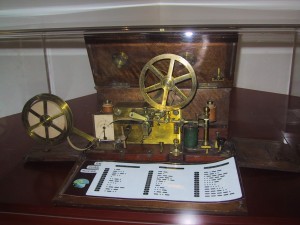
Here at the BRI we love to write about technology that was once cutting-edge,
and has now become obsolete and vanished from the scene. But we
seldom get an opportunity to witness the actual departure.
 In less than a week, the last telegram will be sent. The telegraph was the world’s first mass communication tool. First developed in the 1840s, sending series of electric pulses in Morse code (different combinations of pulses that corresponded to letters of the alphabet) along long stretches of electrical wire made instant communication a reality. The first telegram, sent on May 24, 1844, read, “WHAT HATH GOD WROUGHT?”

Beer has been around for centuries—lots of world cultures have developed some variation on fermented grain and water. But the brews our distant forefathers drank were probably a lot different than the ones we drink now.
 While the ale that was enjoyed centuries before the birth of Julius Caesar may have been tastier than other beverage choices of the day, it was still incredibly sour, with a flavor closer to vinegar than Hefeweizen. That’s according to a team of University of Chicago archaeologists and brewers from the Great Lakes Brewing Company. Using a 5,000-year-old beer recipe outlined in “Hymn to Ninkasi,” an ode to the Sumerian goddess of beer, they brewed up a batch of era-appropriate beer. To help ensure authenticity, they even used recreations of ancient wooden tools and ceramic fermentation pots based on artifacts found in Iraq in the 1930s, malted the barley on a roof, and hired a baker in Cleveland to prepare the bappir (“beer bread”) they used as the source of their yeast. And they heated the beer during the brewing process the old fashioned way: over a manure-fueled fire.

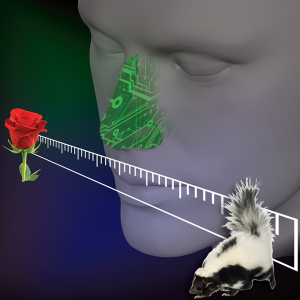 One of the most talked about public pranks last April Fools Day was Google’s announcement of a new service called Google Nose, a tool that would let users search the Internet for smells. It was a joke, of course. But while online smell searching isn’t real, artificial noses are quite real. A California company called Cyrano Sciences is working on a prototype electronic nose that will recognize a preprogrammed array of scents. The company claims their “nose” could help supplement the limited capacity of the human nose. Dangerous, undetectable gas leaks could be picked up by an artificial nose, for example. It could even help doctors diagnose pneumonia and other maladies with distinctive smells. An earlier model, the Cyrano 320, a “portable electronic odor detector” has been used in the food and chemical industries since 2000. NASA also uses a similar device to track down problems on the International Space Station.
Want more weird inventions? Check out our latest book, Uncle John’s Bathroom Reader Weird Inventions.