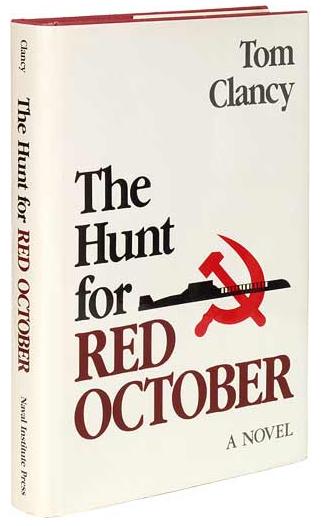
In 1984, a Maryland insurance broker named Tom Clancy wrote The Hunt for Red October, a naval thriller about a Soviet submarine captain who tries to defect to the United States.
Clancy, a military buff, had never published a book before—his only “author” credits were for a three-page article on the MX missile, and a single Letter to the Editor. And the Naval Institute Press had never published a work of fiction. But they liked Clancy’s manuscript, so they bought it and printed 14,000 copies.
A Friendly Hand: President Ronald Reagan read The Hunt for Red October after it was recommended to him by a friend.. .and that’s when a reporter just happened to ask what he was reading. Reagan praised the book as “the perfect yam” and “non-put-downable.”
That did the trick. The Hunt for Red October, which until then had received little attention and was selling slowly, shot up the bestseller lists. Ultimately, it sold more than 5.4 million copies, setting Tom Clancy on a course to become one of the best-selling authors of the 20th century.
Back in 1981, Atari was the world leader in video games. In 1983 Nintendo offered to sell Atari the licenses to their Famicom game system, but they couldn’t come to an agreement, so Nintendo decided to go it alone.
They renamed the American version the Advanced Video System (AVS) and in January 1985, introduced it at the Consumer Electronics Show in Las Vegas, one of the largest such trade shows in the world.
They didn’t get a single order.
Nintendo’s problem wasn’t so much that the AVS was a bad system, but more that the American home video game industry was struggling. After several years of impressive growth, in 1983 sales of video game consoles and cartridges suddenly collapsed without warning. Video game manufacturers, caught completely off guard, lost hundreds of millions of dollars as inventory piled up in warehouses, never to find a buyer. Atari’s loss of $536 million prompted Warner Communications to sell the company in 1984.
Mattel sold off its version, Intellivision, the same year and shut down their entire video game division. Many other companies went out of business.
Science-fiction legend Ray Bradbury died yesterday, as you no doubt heard. We didn’t post anything here – we were waiting for permission to repost something we saw on FaceBook – as good a tribute to the great Mr. Bradbury as we saw anywhere.
Our sincere thanks to Tom Payne in California for allowing us to share this with our readers.
Dick Clark, the music industry maverick, longtime TV host and powerhouse producer who changed the way we listened to pop music with “American Bandstand,” and whose trademark “Rockin’ Eve” became a fixture of New Year’s celebrations, died today at the age of 82.
Clark’s agent Paul Shefrin said in statement that the veteran host died this morning following a “massive heart attack.”
We’ve written about Dick Clark a bunch of times, going all the way back to BR #2. The guy played a larger part in the ushering in of the Rock and Roll era than most people imagine. From USA Today, this morning: