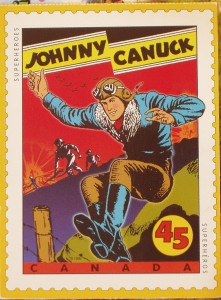
The original Johnny Canuck appeared in newspaper editorial cartoons in the 1860s. A working-class, tall-tale hero in the mold of Paul Bunyan, he sometimes appeared as a lumberjack, at other times as a farmer or a rancher. In 1942, in answer to the war and to the comics ban, the character received a reboot and was resurrected as a Nazi-fighting aviator and secret agent by 16-year-old Leo Bulche, who got the job after a chance encounter with the owner of Dime Comics. Later still, the lumberjack version of Johnny Canuck was adopted as the logo for the Vancouver Canucks, and he occasionally makes appearances on their uniforms on “retro nights.”
CAPTAIN CANUCK
Over the years, Captain Canuck has been the secret identity of three different Canadian secret agents: Tom Evans, Darren Oak, and David Semple. He wears a red-and-white costume based on the Canadian Flag, with a red Maple leaf on his forehead.
WOLVERINE
Wolverine was born in Alberta in the 1880s to the wife of a wealthy farmer and a groundskeeper named Logan, with whom she had an affair. Wolverine is a mutant who has retractable claws and regenerative powers that keep him from aging. In the late-20th century, Wolverine was a part of Canada’s Weapon X program, where his memories were wiped out and he had adamantium fused onto his bones, making him even stronger. A member of Marvel’s X-Men, Wolverine is regularly voted one of the most popular superheroes in the world.
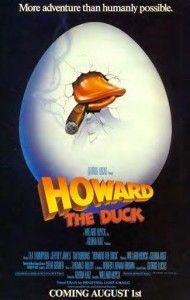
In 1983, George Lucas released Return of the Jedi, the final movie in the Star Wars trilogy, one of the most financially successful and popular film series of all time. But how would he follow it up? In 1985, Lucas announced that he was producing a movie adaptation of the Marvel Comics cult comic book Howard the Duck.
Today, Marvel movies are hot Hollywood properties—this year’s Iron Man 3 and last year’s The Avengers are among the top 20 highest-grossing films of all time. But the very first Marvel property to be made into a movie was Howard the Duck. It was about a humanoid duck from outer space living on Earth, and he was crass, rude, and sexist. Lucas had been trying to get a movie of it made since the mid-’70s, but no studio was interested. After the success of Star Wars, Lucas could make whatever he wanted and Universal readily agreed to distribute Howard the Duck. They needed a big movie for the summer of 1986, and they were still smarting from passing on the Indiana Jones movies, which Lucas had produced and which were distributed by rival Paramount.
Comic book writer Grant Morrison said it best: “[Every bat-suit is] completely different” – sometimes insanely different – “but they’re all instantly recognizable as [the-bat-suit].”
Tomorrow is the 60th anniversary of very first appearance of Charles M. Schulz’s iconic comic strip, Peanuts. Good Ol’ Jay, of BRI “Brainteaser” fame, wrote the definitive BRI history of the strip in Uncle John’s Triumphant 20th Bathroom Reader just a few years ago. In honor of good Charles’ comic strip birthday, here’s a good, lengthy excerpt, telling the story behind the strip’s characters: