We just heard today that the great bluegrass singer and true American treasure Hazel Dickens passed away on Friday.
“Hazel Dickens, a West Virginia-born bluegrass singer who was an authentic voice of America’s working class, has died in Washington at 75.
Ms. Dickens grew up in dire poverty in West Virginia’s coal country and developed a raw, keening style of singing that was filled with the pain of her hardscrabble youth. She supported herself in day jobs for many years before she was heard on the soundtrack of the 1976 Oscar-winning documentary about coal mining, ‘Harlan County, U.S.A.’
Her uncompromising songs about coal mining, such as ‘Black Lung’ and ‘They Can’t Keep Us Down,’ became anthems, and she was among the first to sing of the plight of women trying to get by in the working-class world.”
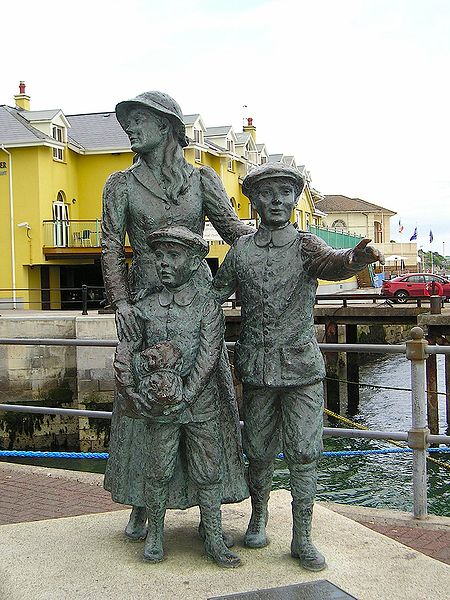
• On page 107, in an article about Ellis Island, now known as Ellis Island National Monument, we mentioned that the very first person to pass through the then brand new federal immigration station, on January 1, 1892, was a 15-year-old girl from Ireland named Annie Moore.
• Yesterday we received an email from BRI fan Nicole H, who said:
For reasons only the mind-faeries know I just thought of the old drive-in theater that I grew up a short walk through a yard and a field from in Western New York. And lo and behold—I found it on the internet. In severalplaces. There’s even an aeriel photo of the site (at the first link) from 1978. And my house is even in there—who knows, I may have even been standing in the yard at the time! (Click pix to enlarge.)
There was a segment on NPR this morning about the growing number of higher education students defaulting on federal school loans. The numbers are astounding: More than 238,000 students with federal loans are in default. And we’ve all heard the horror stories of students accruing debts that will take a decade—or decades—to pay back. (That’s crazy!)
The New York Times reports that the last of the chorus girls from the one-time American entertainment institution, the Ziegfeld Follies, has died:
“For a quarter century, Florenz Ziegfeld auditioned hundreds of thousands of young women vying to become chorus girls, the Ziegfeld Girls, those lace and chiffon visions of glamour who were as much a part of the Jazz Age as Stutz Bearcats, the Charleston and F. Scott Fitzgerald.
In all, from 1907 to 1931, he picked about 3,000, and on Tuesday the last Ziegfeld Girl died. She was Doris Eaton Travis, and she was 106.”
She had quite a story:
Mrs. Travis may have been the youngest Ziegfeld Girl ever, having lied about her age to begin dancing at 14. She was part of a celebrated family of American stage performers known as “the seven little Eatons.” George Gershwin played on her family’s piano, and Charles Lindbergh dropped by for “tea,” Prohibition cocktails.
And she kept on dancing until she was 104, and even appeared at a charity event just two weeks ago.
• Here’s a book that was written about Mrs. Travis in 2006, Century Girl:
Similar in approach to a graphic novel, this biography-in-collage tackles the life of Ziegfeld Follies star Doris Eaton. Each page offers a wild mix of illustrations, doodles, photos and memorabilia from Eaton’s archives, accompanied by handwritten text outlining her fascinating life, which comes across like something out of the musical Gypsy.
While performing an important search for an article one day—okay, I admit it, it was this morning, and I was bored, and I put “pergle” into Google just to see what would happen, you caught me!—I found this blast from the past: Pergl Gas Pump Globes. Remember those?
“Gas globes are spherical glass signs that sat atop gas pumps in the first half of the 20th century, advertising a specific oil company or brand of gasoline. Generally made from a ring of metal with a lens mounted on either side, they were produced in various shapes (like the Shell clamshell) and innumerable designs.
The purpose of gas pump globes was brand identification for drivers at a distance. Lighting wasn’t as good on gas stations as it is today. Sometimes all a motorist could recognize driving by was the gas pump itself lit up, and the globe glowed so they’d know what brand of gas was available. Post World War II, pumps started getting smaller, and by the 1960’s, it was unusual to have a globe.”
Pergl makes reproductions, but there are of course lots of dealers in actual antiqueglobes, and over at OldGas.com, “The Gas Station & Auto Service Collectibles Web Site,” they have a huge gallery of photos of vintage globes.