

“bathroomreader.com” got its name from the Bathroom Readerbook series. Now you know!”
Bing. In development, Microsoft’s search engine was codenamed “Kumo,” But Microsoft went with Bing because focus groups said it reminded them of “the moment of discovery.” The company also liked that it was short, easy to spell, and transferable to languages other than English. (Detractors jokingly claim BING is an acronym for “but it’s not Google.”)
Yelp. The business listings and ratings site is in many ways an Internet version of the Yellow Pages. In fact the “yel” in “Yelp” comes from “yellow,” and the “p” comes from “pages.”
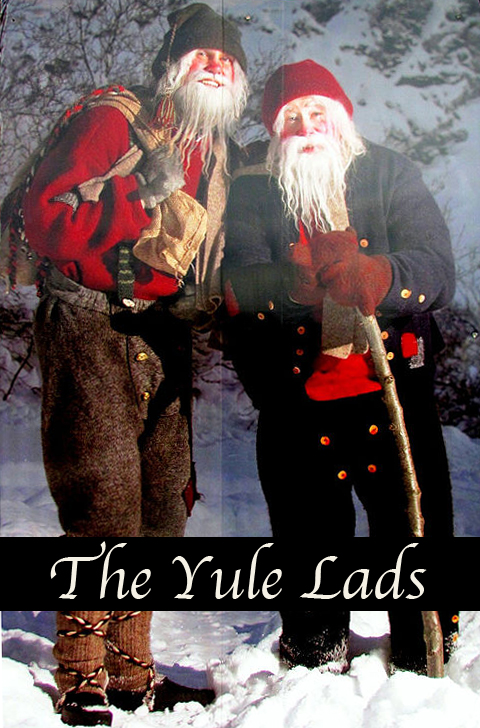
Many countries have their own version of Santa Claus. We recently delved into the unusual traditions surrounding Sinterklaas, the gift giver that sails into the Netherlands every year on a steam ship with bumbling helpers in blackface. Even as weird as that tradition may seem to outsiders, Iceland’s might be even stranger.
In the early 20th century, Clarence Crane ran a candy company in the Cleveland, Ohio, area. His top sellers were chocolate candies, but sales always plummeted during the summer months. Why? Chocolate melts. And in the 1910s, air conditioned stores were not the norm. Then Crane got an idea. Inspired by the hard mints popular in Europe and just beginning to be imported into the U.S., Crane created his “summer candy”—hard peppermint candies that were round and flat, to differentiate from the spherical European ones.
It’s Friday, so that means it’s time for your weekly fake-out. Here’s how it works: Two of the three following stories are true. And one of them we made up. Can you guess which one is the fake? Pick your answer at the end of the article and see if you’re right.
One of the ways that Santa Claus is able to travel all around the world on Christmas Eve is by cutting corners. For instance, he doesn’t widely visit homes in Europe’s “low countries.” Instead, a much skinnier gift-giver covers those regions. His name is Sinterklaas (or just “Sint”). He delivers presents on December 5, on a holiday also called Sinterklaas, to all the good boys and girls…who live in Belgium and the Netherlands.
Instead of a flying sleigh pulled by reindeer, Sint rides a white horse to make his toy deliveries. And instead of spending the offseason at the North Pole, Sint is said to live in Spain. And instead of arriving on a float at Macy’s Thanksgiving Day Parade to herald the beginning of the Christmas season, Sint departs Spain on a steamship and shows up at various celebrations in the middle of November. And no milk and cookies for Sint, please—Belgian and Dutch kids leave Sint’s horse a carrot in their shoes.
With the international reveal of the sixth generation Mustang on its 50th anniversary, we revisit this iconic car’s history. The original Ford Mustang, a sporty car for “everyman” introduced in 1964, is now a symbol of the entire decade. Here’s a bit of its history.
The Mustang was the most successful new car ever introduced by the American auto industry. But in terms of the ’60s, it was more than a car. Its popularity was an expression of the simple truth of the decade—that everyone wanted to look, feel, and act young.
Elf. Buddy the Elf says that elves “try to stick to the four main food groups: candy, candy canes, candy corns, and syrup.” While portraying Buddy, Ferrell ate so much sugar—particularly in the scenes where Buddy eats huge plates of spaghetti covered in chocolate syrup and candy chunks—that he routinely suffered migraines throughout the filming of the movie.
A few weeks ago, we wrote about the Singing Nun, who had an unlikely #1 hit in the U.S. in 1963 with “Dominique,” a song sung in French. Here are some more non-English tunes that topped the American pop chart.
• A rock version of the folk song “La Bamba” is Ritchie Valens’ best-known and signature song, but upon its release in 1959, it was only a minor hit. As the B-side of the #2-hit ballad “Donna,” “La Bamba” hit #23. But when a movie about Ritchie Valens life and untimely death (he died in the same plane crash that killed Buddy Holly and the Big Bopper) called La Bamba was released in 1987, a cover version by the band Los Lobos hit #1. It’s the first and only time a song sung entirely in Spanish has topped the charts.
• In late 1926, Abe Saperstein took over as coach of a touring African-American team in Chicago called the Savoy Big Five (they played their games at the Savoy Ballroom). Saperstein renamed them the Harlem Globetrotters because all the players were African-American (Harlem being a predominantly African-American neighborhood).
• The original lineup for the team’s first game in January 1927: “Toots” Wright, “Fat” Long, “Kid” Oliver, “Runt” Pullins, and Andy Washington.
• The team played hundreds of games a year and got so good that they played in a national championship in 1939 against another independent team, the New York Renaissance. The Globetrotters lost, but that same year they discovered that the crowd liked it when they did ball tricks and comic routines. Saperstein told them to do as much of that as possible…provided they’d already established a comfortable lead.
• Over the years, a few famous athletes have played for the Globetrotters. Wilt Chamberlain played for one year, between college and joining the NBA. Future Hall of Fame pitcher Bob Gibson played in the 1950s, before his baseball career. And NBA great Magic Johnson played in a single game.
These glitzy, glamorous, song and dance spectaculars were dominant TV format in the 1960s and ‘70s. Featuring big production numbers, colorful costumes, comic sketches, and banter between the hosts, extravaganzas Sonny and Cher, Donny and Marie, and The Glen Campbell Goodtime Hour dominated ratings. By 1980 they were simply passé, as the garish ‘70s gave way to the sleek ‘80s. In 1987, ABC attempted to revive the variety show with what seemed like a sure thing. The network signed singer/actress Dolly Parton to a two-year, $44 million contract to star in Dolly. It flopped, and the network bought out Parton’s contract and cancelled the show in less than a year.
There’s nothing worse than trying to concentrate on a very important project (like, say, a blog post) while struggling to tune out loud neighbors. If you live or work in an area with heavy traffic or other types of noise pollution, you’ve likely found yourself wishing you could grab a remote control and turn down the volume on the world outside your window.
It’s Friday, and that means it’s time for your weekly fake-out. Here’s how it works: Two of the three following stories are true. One of them we made up. Can you guess which one is the fake? Pick your answer at the end of the article and see if you’re right.
• In 2003, wildlife conservation officers in Michigan faced a spate of illegal turkey poachers. They didn’t call the Detroit police, one-time employer of Robocop—they brought in Robo Turkey. Several models of the $1,000 animatronic bird were placed in fields and woodlots around the state’s northern counties to protect wild turkeys. Robo Turkey looks like the real thing…from a distance. Officers can operate the bird via remote control to make him move around and shake his tail feathers, in order to attract illegal hungers. Robo Turkey has caught hundreds of poachers in the past decade.
• In 2000, a mysterious man named “John Titor” started posting messages on Internet paranormal discussion forums claiming to be a time traveler from the year 2036. He’d been sent back in time by the U.S. government, he said, to fix software bugs that were making computers in the future malfunction. Titor not only showed off pictures of his time machine (a modified 1967 Camaro), but detailed the scary world events between the years 2000 and 2036. For example, from 2004 to 2008, the second American Civil War was waged; that the 2004 Olympics were the last ones ever held; and that in 2015, Russia started World War III by dropping nuclear bombs on China, the U.S., and most of Europe. Three billion people died and all major world governments crumbled. In March 2001, Titor claimed his IT duties were complete and he “returned” to 2036…which means he never posted on Internet forums again. Obviously, you can figure out that Titor’s details of the future history weren’t quite accurate, making this a hoax. But who was behind it? Nobody knows.
It’s Friday, and that means it’s time to try to fake you out. Two of three stories about stuff being stuffed where it shouldn’t be stuffed are real…and one we made up. Can you guess which one is the fake? Pick your answer at the end of the article and see if you’re right.
Details: French cooks can make even a doughnut—simple dough, cooked in oil—seem fancy. “Beignet” is a deep-fried pastry made out of a versatile dough base called choux. Consisting of little more than butter, flour, eggs, and water, the same dough is used to make other French desserts, including éclairs and profiteroles. A beignet is usually rectangular, served hot, and topped with a mound of powdered sugar.