
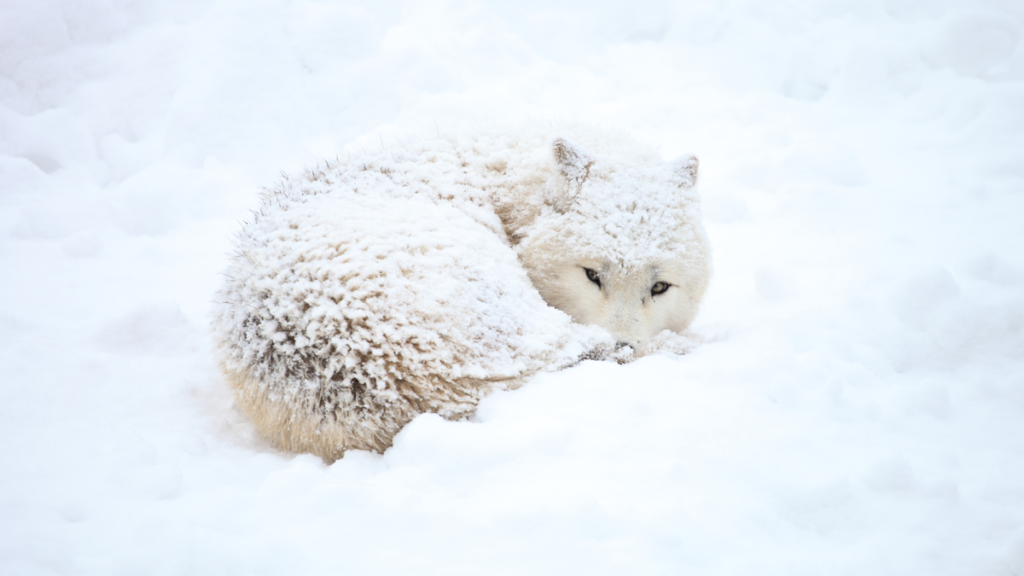
Uncle John is well aware of those special creatures that live and live well in cold climates. But then he wondered, how do they even survive all that snow, ice, and zero-degree temperatures? Here’s how.
Polar Bears
Those majestic and gigantic animals aren’t actually white — their skin is a brownish-black. The white is their fur, or rather the outermost of two layers. That fur is not like other animals’ fur. The hair shafts are made up of a hollow core, which allows for more efficient heat transference and retention. That, plus an extra layer of fat, or what is essentially blubber, just under the skin, helps them lock in warmth when they’re traipsing around the Arctic.
Narwhals
Often likened to unicorns because of the large, protruding horn that sprouts from their foreheads, narwhals are, contrary to popular belief, totally real and not mythological. They’re actually a species of whale, but the rare one that doesn’t migrate, instead spending their whole existence in the Arctic Circle. That horn is actually a tooth, which can grow to be almost nine feet long, and is almost always found only in the male of the species. That tooth allows them to cut through ice and swim to more habitable environments.

Get Uncle John's Know It All Bathroom Reader Today!
Walruses
Perhaps the most famous arctic animal because of their distinctive facial tusks and playful appearances at aquariums and marine life amusement parks, walruses are equipped with multiple biological tools to stay comfortable in frigid. Not only are their bodies lined with an insulating layer of blubber, but they can change their heart rate at will, slowing it down to help their survive especially chilly parts of both land and sea.
Musk oxen
Musk ox do a little bit of everything to stay alive in the punishing cold of the tundra. Their lengthy and very sharp hooves can cut throw snowpack and ice to find delicious roots and moss deep in the tundra on which it feeds. They also travel and reside in communities, where they huddle for warmth. A musk ox is also born with two coats. The undercoat is made up of hair so fine and close together that it insulates the body, while snow, rain, and cold water mostly remain on the surface or outercoat, due to the wicking abilities of the thick guard hairs.
Saiga antelopes
One of the oldest extant animals on earth, the saiga antelope once occupied across the same lands as the woolly mammoth. Living everywhere from northwestern Europe to the northeastern corner of China, saiga antelopes mostly live in Kazakhstan these days, where the temperatures swing wildly from arctic-like in the winter to brutally hot in the summers. Their distinguishing feature — that big nose — is what helps them handle all conditions. That schnozz is outfitted with big chambers that serve as natural filters. They remove dust before it can enter the antelope’s lungs and also cool the hot air as it enters the body. In the winter, it does the opposite, warming up the air as it enters the lungs.