Here’s the fascinating history of the mass market paperback book, made all the more poignant by the recent announcement that low-cost paperbacks will no longer be produced. (Note to readers: Uncle John’s Bathroom Reader is a larger format trade paperback — it’s business as usual over here.)
One could argue that magazines were the first paperback books. Printed on inexpensive paper that didn’t need to hold up over time because the contents were timely and ephemeral, their covers (if they had them at all) were made from the same stock as the insides, or slightly thicker cardstock. Magazines have been around for a couple of centuries, but a step toward paperback books came in the late 19th century with the arrival of pulp. So nicknamed because the quality of paper used was so poor, such periodicals published action, adventure, romance, horror, detective, and generally salacious stories.
The literary and high-minded considered them to be about as good as the paper they were printed on. But they were also extremely popular, with many publishing houses making only pulp fiction, selling them primarily in dime stores and train stations, and recognizable for their bright and suggestive covers — which, like magazines, were thin and much less expensive to produce than the hard, cloth coverings used for more reputable (and costlier) books.
Allen Lane was head of the U.K. publisher The Bodley Head, and by 1935 the effects of the Great Depression were beginning to take a dire hold on the book world. When people had a lot less money they used to on the whole, they weren’t buying a lot of books. At that time, books were expensive and ornate — hardbound or hardback books is what we’d call them today, and they were an investment as much as a source of information and entertainment.
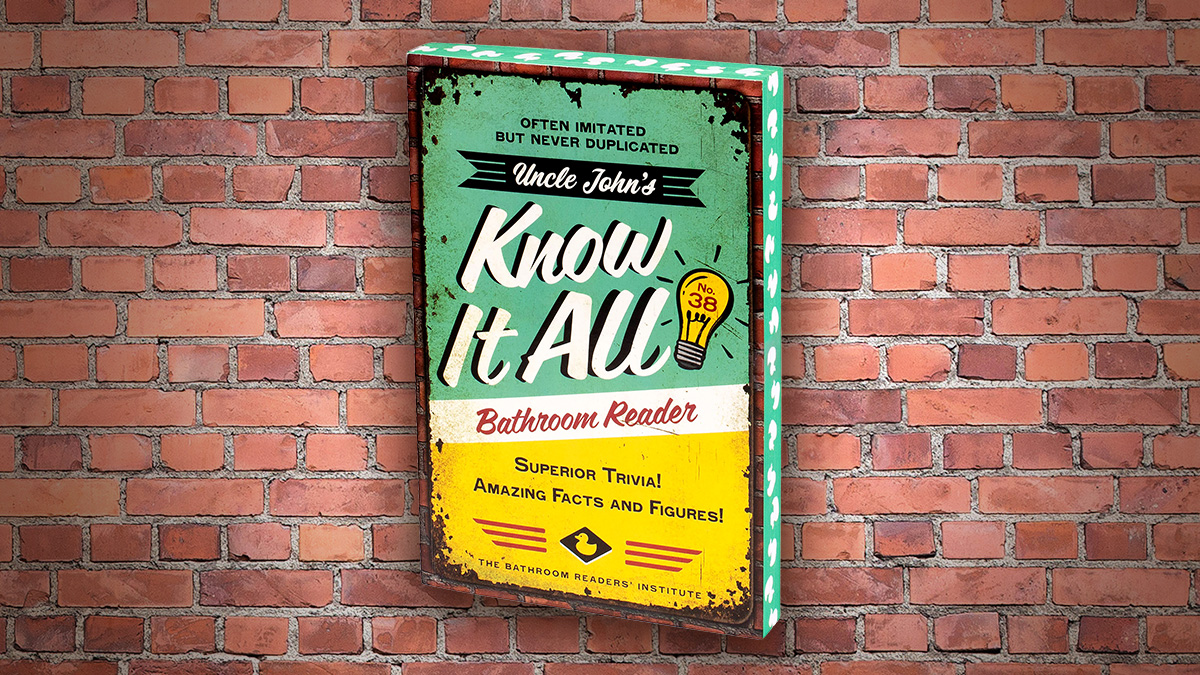
Get Uncle John's Know It All Bathroom Reader Today!
After visiting author Agatha Christie at her country home, Lane was in a train station without anything to read on the way back to London, and all the shops carried were trashy magazines and pulp fiction — salacious novels in the genres of adventure, sleaze, romance, and crime, printed on low-quality paper (hence “pulp”) bound with not a hard or cloth cover, but one of paperboard. It occurred to him that he could apply the pulp fiction technique to more reputable and mainstream literature, and sell decent, respectable books at bargain prices — the same as what Lane said was half a pack of cigarettes.
Lane had trouble convincing his colleagues on the viability of the idea, so he set up a division to make high-quality, paper-bound, or softcover, books. He financed it himself, and he used the same suggested by his secretary: Penguin. He secured the rights to reprint 10 classic novels — including books by Agatha Christie and Ernest Hemingway — and quickly got an order from huge store chain Woolworth’s for 63,500 copies.
The modern paperback was born, and other publishers created their own divisions to sell them. At first it was just reprints of proven successful hardbound books, but then Penguin launched the all-original paperback imprint Pelican, and then the children’s division, Puffin Picture Books. The U.S. moved into the business in 1938 with the arrival of Pocket Books.
In 1943, Council on Books in Wartime, an organization of librarians, aimed to get books to American troops fighting in World War II overseas — inexpensive but interesting ones that would appeal to the general tastes of the average G.I. Consulting with the U.S. Army librarian, they designed a line of cheaply made paperbacks that could fit in the breast or pants pocket of a standard issue uniform. Thus Armed Services Editions were born. They cost seven cents each to make. The first one: The Education of Hyman Kaplan by Leonard Q. Ross. It would eventually publish 1,300 titles — among them The Great Gatsby by F. Scott Fitzgerald, a flop that had been saved from obscurity via this reprint. When the war was over, soldiers returned home with an affinity for paperback books, and that entrenched the idea permanently in America.